Welcome to the Physical Education Department
At Poole High School, we offer students a broad and balanced physical education experience aligned with the guiding principles of the National Curriculum. The physical education curriculum is high-quality and inspires all students to succeed and excel in competitive sports and other physically demanding activities. It provides our students with opportunities to become more physically competent, supporting their health, fitness, and well-being. Our curriculum offers all students the opportunity to compete in sports and other activities that build character and embed values such as fairness and respect.
PE Curriculum Maps
Department Courses
- GCSE Physical Education (Level 2)
- BTEC First Award in Sport (Level 2)
- A Level Physical Education (Level 3)
- BTEC National Foundation Diploma in Sport (Level 3)
- BTEC National Diploma in Sport (Level 3)
Year 7 and 8 (Autumn and Spring term)
Students will be taught a variety of sports over a 4-week block. Activities include Football, badminton , fitness , rugby, netball and handball.
Year 7 and 8 (Summer term)
Students will be taught a variety of sports over a 4-week block. Activities include athletics, cricket, volleyball, pickleball and rounders.
Year 9 (Autumn and Spring term)
Students will be taught a variety of sports over a 4-week block. Badminton, Fitness, OAA, rugby, football, handball and netball.
Core PE
Regardless of their KS4 subject choices, students are entitled to one hour of core Physical Education a week, where they will participate in a variety of sports and activities. We hope to engage, motivate and educate students in the lifelong health and wellbeing benefits of physical activity.
Year 10 and 11 (Autumn and Spring terms)
Boys: football, basketball, table tennis, fitness, rugby, handball and badminton
Girls: badminton, netball, exercise classes, boogie bounce, OAA, yoga/pilates and benchball
GCSE PE students: climbing
Year 10 (Summer term)
Boys: athletics, cricket, rounders, softball and volleyball.
Girls: rounders, tennis, volleyball, cricket, pickleball,
GCSE PE students: athletics, cricket and rounders
GCSE Physical Education
Exam Board: AQA
GCSE PE allows you to further develop practical skills, whilst becoming more knowledgeable about the human body, the socio-cultural influences on and the longer-term benefits of regular participation in safe physical activity. It also improves your ability to analyse and appreciate human movement. The course places great emphasis on the value of healthy, active lifestyles, personal health and well-being. Throughout the course you will have the opportunity to become better performers, leaders and officials. You will also be required to plan, monitor and evaluate a Personal Exercise Programme. The course best suits those with a serious interest in the wider aspects of the subject, who want to develop a greater appreciation of the role of physical activity as part of a healthy lifestyle.
Assessment
Unit 1 -Applied anatomy and physiology, movement analysis, physical training and use of data. This is 30% of the GCSE and is assessed in a written exam of 1 hour and 15 minutes.
Unit 2- Sport psychology, socio–cultural influences, health, fitness and well-being and use of data. This is 30% of the GCSE and is assessed in a written exam of 1 hour and 15 minutes.
Unit 3- Non Exam assessment (NEA)
Practical performances in 3 different physical activities in the role of player/performer (one a team activity, one an individual activity and a third in either a team or an individual activity). Plus a written analysis and evaluation of a performance. This is 40% of the GCSE
BTEC First Award in Sport
Exam board: Pearson
The BTEC First Award in Sport combines practical sports activity with academic study. Students develop their knowledge and understanding by applying their learning and skills in a work-related context. The BTEC First qualification is assessed through a combination of internal and external assessment.
Topics include:
- Unit 1: Fitness for Sport and Exercise (External Exam)
- Unit 2: Practical Performance in Sport. (Internal assessment)
- Unit 3: Applying the Principles of Personal Training. (Internal synoptic assessment)
- Unit 6: Leading Sports Activities. (Internal assessment)
Why study Physical Education?
KS4 Physical Education courses allows progression to A level Physical Education or one of our level 3 vocational qualifications in sport. Both the GCSE and BTEC courses develop transferable, key skills that employers are looking for such as teamwork, adaptability, time management, resilience and independence. Studying Physical Education offers further opportunities in areas such as recreational management, leisure activities, coaching, officiating, the fitness industry and the armed forces.
A Level Physical Education
Exam Board AQA
A Level Physical Education delivers a well-rounded and full introduction to the world of PE, sport and sports science, providing a strong base from which to move on to higher education, employment or further training. The emphasis throughout the course is on the development of knowledge, application of knowledge, competence and confidence in a wide variety of skills. You will learn how Physical Education affects and contributes to society and also how to apply your knowledge from this course to any number of different practical situations or career choices.
Although not necessary to have studied the subject at GCSE, this is strongly advised as previously acquired knowledge of examination PE will underpin learning at this level. There is also an increase in the amount of scientific study, together with the inclusion of data analysis requiring mathematical skills.
The A Level Specification content is divided into three components, which you can see below. Again, each component is further sub-divided into topic areas and the detailed content associated with those topics.
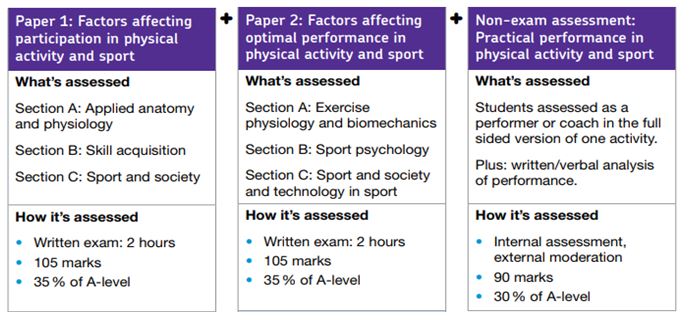
*Please note that you will be assessed on your practical ability to participate in a sport, demonstrating attacking, defending skills and tactical awareness so must be playing a sport on the AQA specification to club standard.
Skills that will be developed
A Level PE students develop the ability to demonstrate knowledge and understanding of physical activity, and to apply this to a range of sporting contexts. Analytical and evaluative skills are developed through both written and oral responses.
BTEC Nationals in Sport
Exam board: Pearson
We also offer the following BTEC qualifications in sport. They all combine practical sport activity with academic study. Students develop their knowledge and understanding by applying their learning and skills in a work-related context. BTEC Nationals are assessed through a combination of internal and external assessment.
- BTEC National Foundation Diploma in Sport is a two year programme, equivalent to 1 1/2 A levels and is studied for 9 lessons a cycle.
- BTEC National Diploma in Sport is a two year programme, equivalent to 2 A levels and is studied for 18 lessons a cycle.
Extra-Curricular Clubs
The government recommends 60 minutes of physical activity per day; therefore, all clubs are free and open to all abilities. We encourage students to attend weekly club meetings to benefit from coaching and to represent our school in PEDSSA leagues and competitions.
What clubs are available? A full list of clubs is available on the website, outside the PE office and in the changing rooms.
When are the clubs? All clubs take place between 15:00 and 16:00.
How do I sign my child up for clubs? Student just turn up at the changing rooms with their kit at the end of the day and they can join in.
Do we have to pay for clubs? No, most clubs are free. We sometimes offer students opportunities to work with specialist coaches who charge fees. Please check the PE clubs list for details.
How does my child get selected for school teams? Students are encouraged to attend clubs regularly, and team sections will be made from these club nights. If a child is not initially selected to represent the school, we encourage them to continue attending training to improve their skills and remain available should spaces on the team arise.
Do I have to give permission each time my child leaves site? You will have been sent a consent form at the start of the year that covers all PE fixtures and core activities.
How can I obtain information about fixtures? All PE clubs finish at 16:00; some fixtures will finish later. Students will be invited to a Teams classroom where the information will be posted. PE staff will also meet with the squad during the week of the fixture to confirm attendance. Students are responsible for verifying this information and ensuring that they attend the meeting (usually during a break in the PE area). If your child is attending a fixture and will be off-site, you will also receive a text message with the details and pickup time.
How will I find out if clubs or fixtures are cancelled? We will endeavour to inform students as early as possible if fixtures or clubs have been cancelled. You will also receive a text message if the fixture is no longer proceeding, so you are aware that your child remains on-site.
Can I spectate at my child's fixture? Once the school day has finished, parents are allowed on-site to spectate. Please ensure that you sign in and out at the reception desk. No access will be possible during the school day. You will find that this is commonplace across all schools. If you would like to spectate at an away game, please check the host school's policy.
How do you celebrate sporting success? We celebrate students' success through our social media channels and sports awards evening. Parents will have the opportunity to inform the PE department of their child's sporting success and level of participation via the Sporting Stars Teams form sent home. We are also a TASS-accredited school. This accreditation enables us to work with Sport England to support high-level National and International athletes in their dual-career aspirations.
PE Department FAQs
How many lessons a week will my child have? Each lesson is an hour long, and over the two weeks, Year 7 & 8 have 4 lessons, Year 9 has 3 lessons, Year 10 & 11 have 2 lessons, and Sixth Form has the option of 1 hour per week through the enrichment programme.
Where will these lesson take place? Sports such as table tennis, dance, badminton, climbing and fitness will take place inside. Other sports will be taught outside whenever possible.
Does my child need to bring their own equipment for each lesson? No, we provide all necessary equipment, such as rackets, bats, and balls. Students are welcome to bring their own equipment to clubs, provided it is labelled and can be stored safely.
Will my child have the same PE teacher each lesson? We do our best to keep the same teacher with the same class; however, we have part-time staff, so students may benefit from a number of staff members.
Will the PE groups remain the same for the whole year? Over the academic year, groups may change in response to staffing.
Is there a gender split? Sports are predominantly taught in single sex groups. We offer GCSE and BTEC PE courses that will be mixed-gender.
Do students have any choice in the activities that they participate in? Students study a range of team and individual sports in KS3, in line with National Curriculum requirements. At KS4, students have the option to progress to allow a more personalised PE programme. This is regularly reviewed.
How are students' strengths recognised in PE? Students are awarded whole-school Valued, Inspired, and Empowered points in lessons for demonstrating behaviours aligned with these values. Specifically in PE, we take a holistic approach to assessment through our Show, Know and Octo strands. In each lesson, students are expected to demonstrate a range of movement skills to be practised and developed (e.g., passing, shooting, moving into space, running, jumping, throwing, defending, attacking and components of fitness), and to demonstrate their knowledge by the end of the lesson (e.g., rules, tactics, players, historic sporting events, current competitions, world records which may relate to skills, tactics or strategies).
Which items of equipment are required, and when? Your child will rotate through the activities listed in the relevant Key Stage tab. Your child will be informed before each activity block of the kit that they need to bring for that lesson.
What happens if my child forgets an item of kit? They will receive a first warning and be lent the required items of kit. This will be recorded at the front of their planner. If your child forgets their kit again, they will be issued a second warning; on the third occasion, they will receive a detention. Kit warnings are reset at the start of each term. Refusal to borrow a kit will result in removal from the lesson and the issuance of a detention.
Where does my child keep their kit? Students must carry their kit in a PE bag on days when they have PE.
My child has lost their PE kit. What should I do? Ask your child, in advance of their next PE lesson, to retrace their steps, looking in classrooms, the PE changing rooms, lost property and reception. Do send a note to their PE teacher if you need a few days to look, or to let us know when they will have a replacement kit. That way, your child will not receive a warning. They will be provided with a kit to ensure they can still participate in the lesson.
What is the policy on Jewellery in PE? Please refer to the school behaviour policy, which includes all information regarding jewellery.
My child is too injured to take part in a lesson. What should I do? All students are expected to take part in PE. Students who are injured must provide a note in their planner explaining why they cannot participate physically in PE. The student will still be expected to bring their kit, change and participate in a leadership role. Please include the date by which your child expects to return to practical PE.
Where should my child keep their asthma inhaler or EpiPen during PE lessons and clubs? Students are required to carry their inhalers to lessons, where they should be placed in a safe location or kept with the teacher. EpiPens are stored in a central area of the school for quick access if needed. Teachers will also be aware of any medical conditions of students in their group.
Are shin pads essential? Yes. Shin pads are mandatory under FA regulations for gameplay. This includes lessons, after-school clubs and fixtures. Students may be unable to participate in extracurricular clubs if they do not have them. Please ensure that shin pads are named.
Is a mouthguard recommended? Yes, for contact rugby in an after-school club, a gum shield is essential. These are readily available from sports shops or the PE department. Rugby in lesson time does not require a mouthguard
Does my child need football boots? Football boots are recommended but not essential for football and rugby. They will prevent slips in wetter conditions and prevent trainers from getting muddy. Please ensure that they are moulded studs.
What trainers are suitable? We recommend sports trainers with laces on. Trainers such as high tops, skate or fashion trainers are not appropriate and not part of the school uniform.
Does my child change their socks for PE? Can they wear tights for PE? For hygiene reasons, students must wear navy football socks (winter) or white ankle socks (summer) during PE. Tights must not be worn.
My child is on their period. How can we prepare them to participate in lessons as expected? Moderate-intensity exercise helps reduce bloating and crampy pain. Students may change their sanitary wear during break time or lunch, and we have toilets in the changing rooms. There is a free supply of pads and tampons in the changing rooms for students who require them.
What equipment is needed for swimming? One-piece swimsuit (no bikinis) or swimwear, swim hat, towel, and a bag for wet clothes. Goggles may be used if your child prefers to swim with them. If students are unable to swim due to their menstrual cycle, please send them to school with a signed, dated note from a parent/ guardian. Students will still be required to change into a PE kit, as they will assume the role of a coach and may participate in dry-side rescues. They are likely to get splashed, so this is also to protect their school uniform. Students will be expected to swim within a week, assuming their menstrual cycle has finished. There is now a range of period swimwear available in shops that some students choose to use so that they don't miss lessons.
My child cannot wear a traditional swimsuit due to religious reasons. What do we do? Students are encouraged to wear clothing that makes them comfortable in the water. Long-sleeve rash vests, water leggings, or an all-in-one swimsuit can provide a suitable option for swimming whilst adhering to religious beliefs.
Careers in sport, fitness and physical activity continue to grow, driven by a national focus on health, wellbeing and active lifestyles. According to Sport England and the Office for National Statistics, physical inactivity costs the UK economy over £7 billion per year, highlighting the increasing importance of skilled professionals in physical activity, health promotion and wellbeing across education, healthcare and community settings.
Studying Physical Education (PE), A Level PE or a BTEC National in Sport equips students with the knowledge, practical skills and resilience needed to succeed in further education, training and employment. These courses provide strong progression routes into higher education and careers such as sports science, physiotherapy, coaching, teaching, sports management, psychology, nutrition and wider health-related professions.
Alongside academic learning, students develop highly transferable skills including teamwork, leadership, communication, problem-solving and independent thinking — skills that are valued by universities, employers and apprenticeships alike. PE and sport courses support positive destinations and prepare students effectively for life beyond school.
UK Government (2022) Physical activity: applying All Our Health. Available at: https://www.gov.uk/government/publications/physical-activity-applying-all-our-health/physical-activity-applying-all-our-health
You can follow us on X at Poole High Sport